CPHI Milan 2026: Investment Is Only Half the Story
20 Oct, 2026



Scale is no longer a problem for after approval. It is part of the case.Cell and gene therap...


Scale is no longer a problem for after approval. It is part of the case.
Cell and gene therapy (CGT) has proven it can work. What it has not yet proven is that it can be made at the volume, consistency and cost that commercial demand requires.
Three forces are pushing developers to close that gap earlier: the economics of manual manufacturing, a regulatory environment that looks harder at commercial readiness, and an EU access process that now runs once for every member state. For Tech Ops and CMC leaders, that changes when automation decisions get made and who needs to be in the room when they are.
Most commercial autologous CAR-T products still rely on a centralised model, with turnaround times of 21 to 37 days. Much of the process runs in open steps handled by operators in cleanrooms, one batch per patient.
That model is expensive and fragile. Open transfers are where contamination and failures happen, and the people running them are hard to keep: operator turnover in cell therapy manufacturing has been estimated at around 70% within 18 months. Scaling a manual process means hiring more of the people who are already leaving.

Closed, automated platforms are moving from pilot to programme. A fully automated, closed process has the potential for a four-fold reduction in process failure rates by removing open transfers and limiting manual steps. Systems such as Lonza's Cocoon and Cellares' Cell Shuttle are being used for decentralised and gene-edited cell therapy manufacturing.
For vector and nucleic acid production, the equivalent shift is toward intensified and continuous processing, where upstream and downstream steps run without the hold points of a traditional batch. The goal is the same in both cases: fewer manual interventions, more data per run, and a process that can scale without being redesigned.
Regulators are encouraging it. FDA's Advanced Manufacturing Technologies Designation Program now covers automated manufacturing methods for cell-based therapies. The catch is timing. A platform change after pivotal lots triggers comparability, and a change after PPQ can mean repeating it.
EU joint clinical assessments. The EU HTA Regulation became operational on 12 January 2025, starting with oncology medicines and ATMPs. The European Commission has now published the first joint clinical assessment report for an ATMP, on Novartis' Itvisma. Orphan medicines follow in 2028.
The JCA assesses clinical effectiveness, not manufacturing. But it moves the access conversation earlier and makes it EU-wide. A product that can only supply one or two markets at launch will find that gap visible sooner, and harder to explain.
FDA expectations. Expedited pathways such as RMAT shorten the clinical timeline, which leaves less time to mature the process. FDA's CMC Development and Readiness Pilot, which programmes such as Intellia’s lonvo-z have used, exists because CMC readiness has become the pacing item for fast-moving programmes.
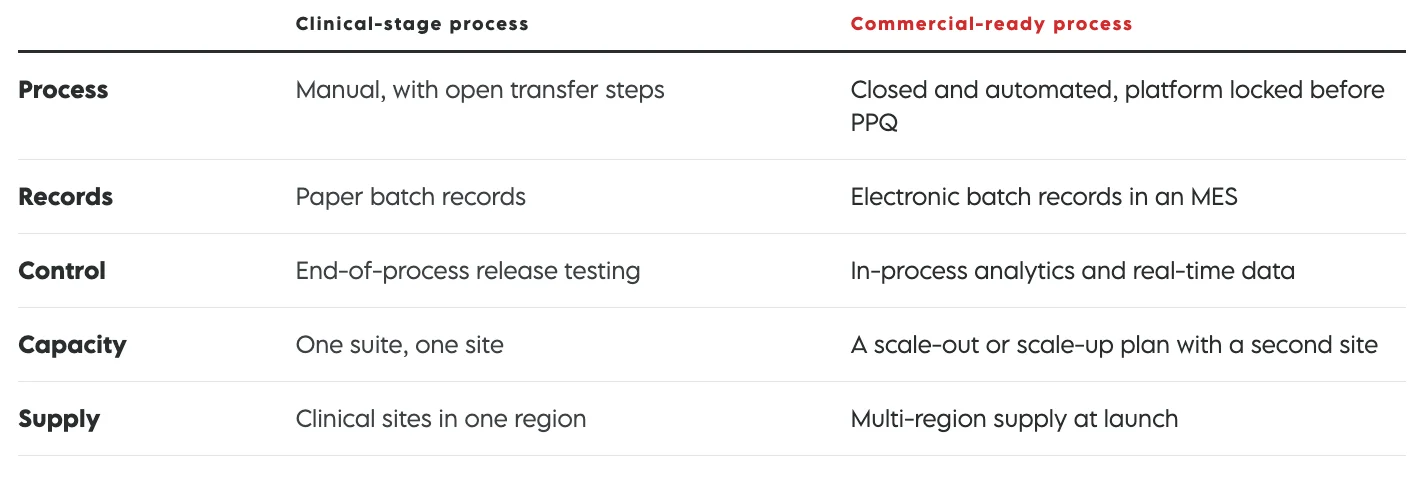
None of this is new thinking. What has changed is the date by which it has to be true. Programmes that treat automation as a post-approval optimisation now risk carrying a comparability exercise into review.
Automation reduces the number of operators a process needs. It increases the number of specialists needed to design, validate and run it.
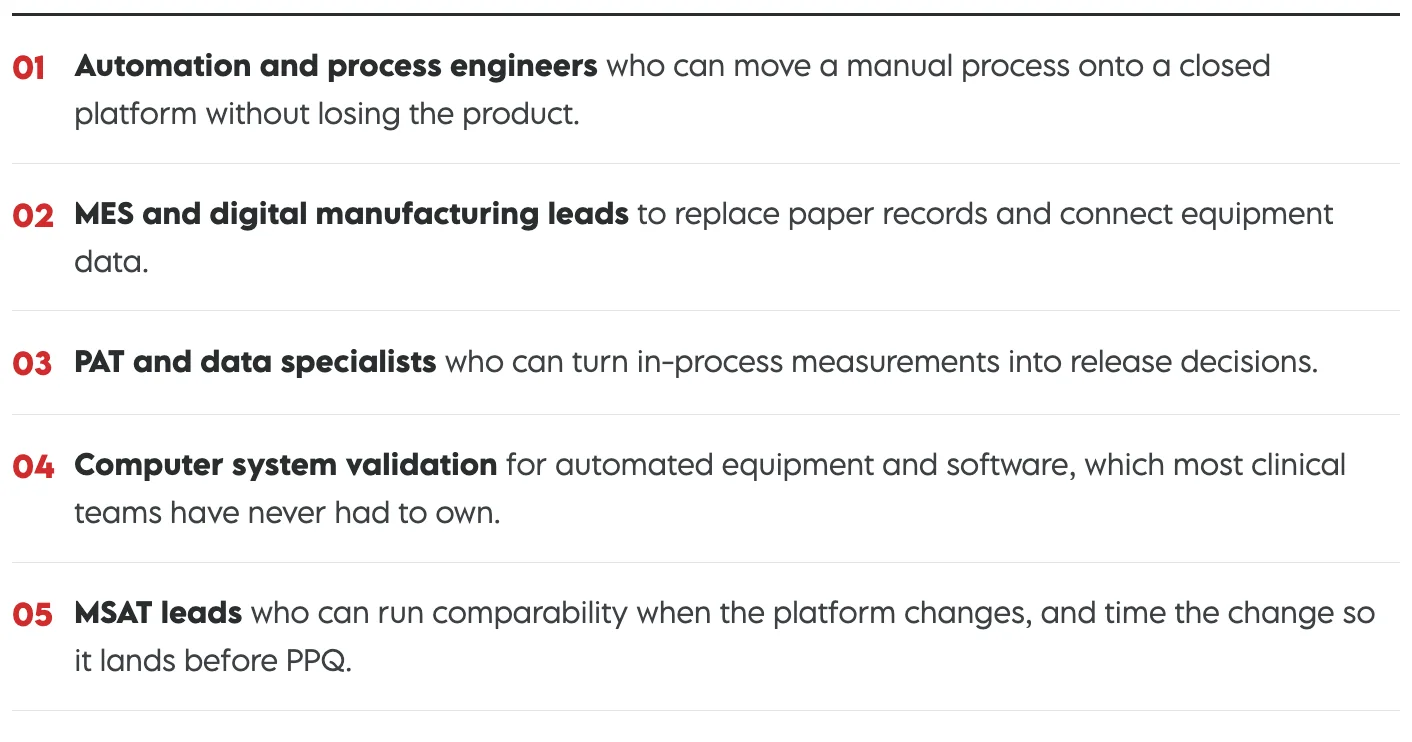
Many of these profiles sit outside CGT, in biologics, vaccines and medical devices. The skill is in finding the ones who can learn a living product quickly. Demand is rising: in some US regions, demand for cell therapy manufacturing workers could grow by as much as 136% within a decade.
Moving from development into scalable, commercial manufacturing changes the expertise you need around the process.
Our Manufacturing & Tech Ops recruitment team places specialists and leaders across automation, MSAT, digital manufacturing, validation and process development throughout the US, UK and EU.
Holly Wallner, Associate Director, Global Client Partnerships, can help you identify the critical hires your commercial process needs, when to bring them in and where specialist CGT experience matters most.