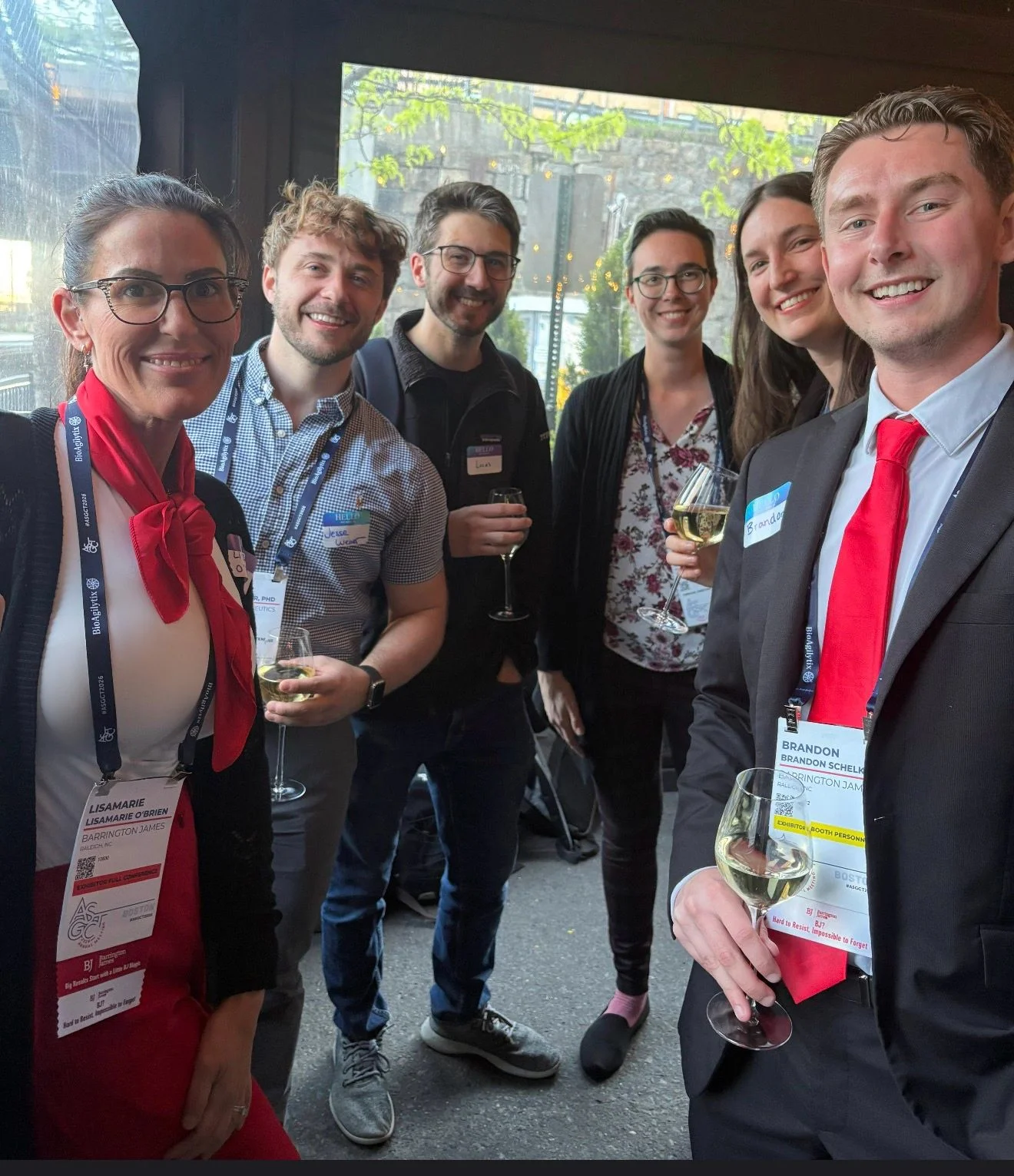
From Boston to Las Vegas, Nashville to Philadelphia, Q2 2026 saw the Barrington James team on the ground at some of the most influential conferences across life sciences.
That's not by chance.
We attend more conferences than any other life science recruitment partner.
Why? Because the sharpest read on where this market is heading rarely comes from the stage. It comes from the conversation after the panel, the comment over coffee, the thing nobody puts in a slide deck. Face to face still wins. Trust builds faster, conversations go deeper, and what we bring back reflects that.
Fractional Leadership Takes Centre Stage
CMO Summit 360° – Boston, Massachusetts
The CMO Summit 360° brought biotech Chief Medical Officers together in a room that felt as much like a reunion as a conference, with high energy carrying through panels built around clinical development, outsourcing and leadership.
Key trends:
- Fractional and contract CMO and clinical development leadership are moving from niche to mainstream, with executives splitting 5 to 20 hours a week across multiple pipelines
- Biotechs are turning to fractional leadership specifically to protect runway while still accessing senior strategic input for investor meetings and programme planning
- Strong appetite among CMOs for flexible models that let them stay focused on the most critical priorities rather than spreading thin across one company
- High engagement and reconnection across the CMO community pointed to renewed confidence heading further into 2026
Hiring implications:
Demand for fractional and contract CMOs and clinical development leaders is accelerating, particularly among biotechs that need senior strategic input on a flexible, runway-conscious basis.
AI and GLP-1s Are Rewriting the Access Playbook
AMCP 2026 Annual Meeting – Nashville, Tennessee
More than 4,000 managed care pharmacy leaders gathered in Nashville for AMCP 2026, with conversation dominated by where specialty is heading next and how AI is reshaping the formulary decisions sitting behind it.
Key trends:
- Specialty pipeline momentum is building fast across orphan drugs, precision oncology and GLP-1 real-world evidence
- AI is increasingly embedded in formulary and access decision-making, shifting from talking point to working tool
- GLP-1 affordability is under sustained scrutiny, with some patients now better served buying direct than routing through insurance
- Commercial and market access teams are under growing pressure to keep pace with rising specialty complexity
Hiring implications:
Rising need for market access, HEOR and formulary strategy professionals who can bridge AI-enabled decision tools with the operational reality of specialty and GLP-1 portfolios.
The Industry's Playbook Needs a Rewrite
ACRP 2026 Annual Conference – Orlando, Florida
More than 1,300 clinical research professionals gathered in Orlando for ACRP's 50th anniversary conference, with the mood reflecting an industry that knows it's at an inflection point. The headline coming off the event was direct: what got us here won't get us there.
Key trends:
- AI moved from aspiration to application, with focused sessions on real-world use cases across trial feasibility, patient recruitment, oncology data review and administrative automation, and a clear message that the organisations pulling ahead are those rebuilding processes around AI rather than bolting it on
- Workforce sustainability resurfaced as a core concern, with turnover among clinical research professionals cited as a direct driver of increased trial costs and delayed timelines
- Study start-up speed remains a top priority, with debate continuing around centralised versus decentralised models and how to compress the time to site activation
- Patient engagement and digital trial integration were prominent themes, with growing emphasis on EMR connectivity and digitally driven compliance rather than paper-based workflows
- Leadership development ran as a thread across multiple sessions, with panellists pushing back on traditional definitions of seniority and encouraging attendees to lead from wherever they sit
Hiring implications:
Growing demand for digitally capable clinical operations professionals who can work within AI-enabled workflows, alongside continued pressure to retain experienced site and CRC talent in a market where turnover is actively disrupting trial delivery.
Specialty Pharmacy Is Hitting Its Limits
Asembia's AXS26 Summit – Las Vegas, Nevada
Nearly 10,000 attendees across four days at Wynn & Encore Las Vegas made AXS26 another record year for the specialty pharmacy ecosystem. The scale of the event matched the scale of the challenge being discussed: transformative therapies are arriving faster than the systems built to pay for and deliver them.
Key trends:
- Drug pricing policy is no longer a slow-moving background issue. The IRA, MFN pricing mechanisms and the Consolidated Appropriations Act of 2026 are translating directly into payer behaviour right now, with Medicare-negotiated prices increasingly being used as commercial reference points
- Cell and gene therapy scale-up is becoming a critical bottleneck. Current distribution and financing models were built for small patient volumes. As approvals grow and indications expand, the infrastructure is under serious strain
- PBMs are under structural pressure, with FTC settlements and new transparency requirements pushing the market toward fee-based compensation models and away from spread pricing
- More than 20% of branded drug net sales face loss of exclusivity from over 30 brands generating more than $1 billion annually, adding urgency to commercial and access pipeline planning
- GLP-1 affordability continues to be contested, with some patients finding direct purchase more cost-effective than routing through insurance
Hiring implications:
Sharp demand for market access, payer strategy, specialty pharmacy operations and outcomes-based contracting professionals who can operate at the intersection of pricing pressure, policy volatility and complex therapy delivery.
In Vivo Has Moved From Promise to Practice
ASGCT 2026 Annual Meeting – Boston, Massachusetts
Day one at ASGCT 2026 set the tone for the week. In vivo gene and cell therapy is no longer the frontier, it's the baseline expectation, with breakthrough data and hiring pressure arriving in equal measure.
Key trends:
- Major in vivo breakthroughs dominated headlines, including precise brain editing delivered via a single AAV, an in vivo CAR-T surrogate achieving deep B-cell depletion without lymphodepletion, and HIV CAR-T data that broke into mainstream press
- Delivery science, capsid engineering and editing platform leadership now sit at the centre of competitive advantage, not in a supporting role
- Companies are racing toward commercial readiness and launch planning at the same time the underlying science is still accelerating
- Early-stage biotechs and CDMOs alike are stretched thin trying to balance speed to clinic, technical depth, scalability and keeping good people engaged in a highly competitive market
Hiring implications:
Sharp rise in demand for delivery scientists, capsid engineers and editing platform leads, alongside CDMO hiring strategy support and scientific leadership as companies prepare for commercial launch.
HEOR Is No Longer a Support Function
ISPOR 2026 – Philadelphia, Pennsylvania
Nearly 5,000 healthcare stakeholders gathered in Philadelphia under the theme "HEOR at the Forefront of Policy, Access, and Value," and the conversations matched the ambition of that framing. The field is being asked to do more than generate evidence. It's being asked to drive strategy.
Key trends:
- AI ranked as ISPOR's number one HEOR trend for 2026-27, with the consensus shifting away from isolated pilot projects toward organisations rebuilding entire evidence workflows around it as default practice
- Real-world evidence continues to grow in influence, with sessions exploring its expanding role across regulatory submissions, HTA decision-making, rare disease research and comparative effectiveness
- Drug pricing policy dominated the plenary agenda, with the IRA, MFN pricing strategy and Medicare negotiations dissected for their impact on development decisions, launch planning and long-term innovation incentives
- Patient-centred evidence generation moved from principle to implementation focus, with sessions examining how PROs, caregiver burden data and patient preference research can be embedded directly into clinical and economic models
- HEOR is increasingly being positioned as a strategic C-suite capability rather than a downstream compliance function, with growing emphasis on linking evidence output to investment decisions and commercial strategy
Hiring implications:
Rising need for HEOR professionals with AI fluency and strategic communication skills, alongside market access and RWE specialists who can operate across a rapidly shifting global policy landscape.
Sites Are Telling Vendors Exactly What They Need. Is Anyone Listening?
SCRS West: Site Innovation Summit – Scottsdale, Arizona
The SCRS West Site Innovation Summit brought together clinical research sites, sponsors, CROs and technology providers at The Scott Resort in Scottsdale for two focused days of collaboration. The format is deliberately site-led, and the feedback from the floor was pointed.
Key trends:
- Technology burden on sites came up repeatedly as an unresolved problem. The message from attendees was consistent: the industry is adding tools faster than sites can absorb them, and complexity is starting to work against trial efficiency rather than for it
- AI adoption at the site level is early but real, with examples shared of AI being used for patient pre-screening, scheduling automation and simplification of participant materials. Vendors are increasingly building in human-in-the-loop models to address site concerns around control and quality
- The gap between tech built in isolation and tech that sites actually adopt was a central theme, with strong appetite for solutions developed through genuine site input rather than delivered as finished products
- Workforce development featured alongside technology, with sessions covering how to build more resilient site teams and retain staff in an operationally demanding environment
- Collaboration across the ecosystem was framed as the priority, with sponsors and CROs encouraged to listen more directly to what sites need before decisions on tools and workflows are made
Hiring implications:
Continued demand for site operations, clinical technology and patient recruitment professionals who can work across a more digitally complex trial environment, alongside growing interest in staff who can bridge the gap between vendor tools and real-world site delivery.
Quality Over Quantity, and AI Everywhere
DIA 2026 Global Annual Meeting – Philadelphia, Pennsylvania
DIA 2026 felt more intimate than previous years, with a smaller exhibit hall and a lighter attendance footprint, but that shift in scale didn't dull the quality of the conversations. The people who were there were engaged and the reconnections were genuine.
Key trends:
- AI dominated the vendor floor to an almost overwhelming degree, with nearly every booth anchored around some form of AI platform, model or integration play. At points, it felt closer to a tech conference than a life sciences one, with the bandwagon effect in full view
- CRO presence was heavy from a vendor standpoint, reflecting the continued push toward outsourcing as companies manage costs and bandwidth
- Despite a competitive recruitment landscape, with five or more competitor firms running booths, Barrington James was consistently cited as the standout presence on the floor
Hiring implications:
With AI adoption accelerating across clinical operations and CRO partnerships deepening, demand is growing for professionals who can sit at the intersection of technology and drug development, not just use AI tools but also critically evaluate and implement them within real trial environments.
These Insights Are Exactly Why We Show Up
You can't get this level of understanding from a press release or a second-hand recap. It comes from being in the room, having the honest conversations that don't make it into a keynote.
That's what separates a recruiter from a true market specialist.
Want to Learn More?
Every trend in this round-up, from fractional leadership to the in vivo talent crunch, is explored in greater depth in our Life Sciences Workforce Outlook 2026 report. If you're benchmarking your hiring strategy against where the market is actually heading, start there.
Let's Keep in touch.